Can AI Be Truly Creative? An article in American Scientist
Art and science have always influenced each other, but AI provides a medium for these spheres to fuse and create new forms of expression and discovery. […]
Articles featuring Arthur I. Miller’s observations on creativity and AI
Art and science have always influenced each other, but AI provides a medium for these spheres to fuse and create new forms of expression and discovery. […]
Go grandmaster Lee Sedol recently announced he was retiring from the game because “there is an entity that can never be defeated”: AI. As readers likely remember, an artificial intelligence known as AlphaGo defeated Lee in 2016. The grandmaster later commented that AlphaGo had displayed “human intuition.” AI is in the news regularly these days, but one … Read more
Ross Goodwin has had an extraordinary career. After playing about with computers as a child, he studied economics, then became a speech writer for President Obama, writing presidential proclamations, then took a variety of freelance writing jobs.
One of these involved churning out business letters—he calls it freelance ghostwriting. The letters were all pretty much the same, so he figured out an algorithm that would generate form letters, using a few samples as a database. […]
So you’re saying we’ll one day connect with machine art as profoundly as we do now with human art?
Yes. The machine sees the world in a different way than we see the world. Just like an artist does. That gives you an inkling that machines will have a different physiology. In time, they will evolve emotions. Just from scanning the web now, they could imitate our emotions. They’ll say, “Oh, thirst, that’s cool. I think I’ll be thirsty,” and they can convince you they’re thirsty. […]
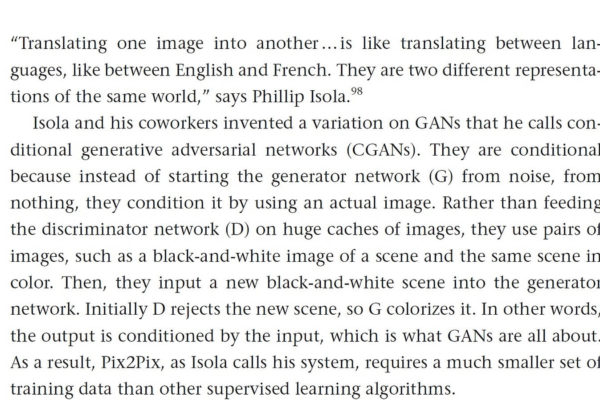
Amazing concept, as defined by Ford Madox Ford: ‘Open any book at page 99 to reveal the quality of the whole’!
Here’s what happens when you open The Artist in the Machine at p. 99 …

Eduardo Miranda wants to shake up musical composition. At the moment, he is interested in central processing units (CPUs). In today’s computers, CPUs are silicon chips with circuitry that enables them to perform arithmetical, logical, and control operations. But supposing we go beyond silicon, beyond digital, beyond even a quantum computer? What about, for example, a bioprocessor that powers a biocomputer? …
Someday, artificial intelligence could become so advanced that it gains the ability to think creatively — and, perhaps, so vastly surpasses humanity’s artistic abilities that it would have to explain its creations to our squishy, primitive brains. At least, that’s one of the predictions that physicist, philosopher, and creativity scholar Arthur Miller makes in his new book, “The … Read more
Thrilled to be excerpted in Papaya Rocks. Today, computers are creating an extraordinary new world of images, sounds, and stories such as we have never experienced before. Gerfried Stocker, the outspoken artistic director of Ars Electronica in Linz, says provocatively, “Rather than asking whether machines can be creative and produce art, the question should be, … Read more